<?xml version="1.0" encoding="UTF-8"?>
<rss version="2.0"
	xmlns:content="http://purl.org/rss/1.0/modules/content/"
	xmlns:wfw="http://wellformedweb.org/CommentAPI/"
	xmlns:dc="http://purl.org/dc/elements/1.1/"
	xmlns:atom="http://www.w3.org/2005/Atom"
	xmlns:sy="http://purl.org/rss/1.0/modules/syndication/"
	xmlns:slash="http://purl.org/rss/1.0/modules/slash/"
	>

<channel>
	<title>Past Imperfect, The Art of Inventive Repair</title>
	<atom:link href="http://andrewbaseman.com/blog/?feed=rss2" rel="self" type="application/rss+xml" />
	<link>http://andrewbaseman.com/blog</link>
	<description></description>
	<lastBuildDate>Sat, 18 May 2013 23:35:32 +0000</lastBuildDate>
	<language>en-US</language>
	<sy:updatePeriod>hourly</sy:updatePeriod>
	<sy:updateFrequency>1</sy:updateFrequency>
	<generator>http://wordpress.org/?v=3.5.1</generator>
		<item>
		<title>Porcelain blue &amp; white jug, c.1785</title>
		<link>http://andrewbaseman.com/blog/?p=6141</link>
		<comments>http://andrewbaseman.com/blog/?p=6141#comments</comments>
		<pubDate>Sat, 18 May 2013 17:30:06 +0000</pubDate>
		<dc:creator>Andrew Baseman</dc:creator>
				<category><![CDATA[jug]]></category>
		<category><![CDATA[blue & white]]></category>
		<category><![CDATA[bronze]]></category>
		<category><![CDATA[Chinese]]></category>
		<category><![CDATA[metal handle]]></category>
		<category><![CDATA[Qianlong]]></category>
		<category><![CDATA[rattan]]></category>

		<guid isPermaLink="false">http://andrewbaseman.com/blog/?p=6141</guid>
		<description><![CDATA[Chinese porcelain baluster-form hot milk jug with sparrow beak spout, made in the mid to late 18th century during the Qianlong Period (1736-1795). Delicately decorated in underglaze cobalt blue showing a large vase filled with precious objects sitting on a carved wood table, a pair of bees and flowers. The scale of these objects is a [...]]]></description>
				<content:encoded><![CDATA[<p>Chinese porcelain baluster-form hot milk jug with sparrow beak spout, made in the mid to late 18th century during the Qianlong Period (1736-1795). Delicately decorated in underglaze cobalt blue showing a large vase filled with precious objects sitting on a carved wood table, a pair of bees and flowers. The scale of these objects is a bit off-kilter, which adds a whimsical quality. Jug measures 5-3/4&#8243; high and 4&#8243; wide to the end of handle.</p>
<p><a href="http://andrewbaseman.com/blog/wp-content/uploads/IMG_9900.jpg"><img class="alignnone size-full wp-image-6369" title="IMG_9900" alt="" src="http://andrewbaseman.com/blog/wp-content/uploads/IMG_9900.jpg" width="400" height="416" /></a></p>
<p><a href="http://andrewbaseman.com/blog/wp-content/uploads/IMG_9908.jpg"><img title="IMG_9908" alt="" src="http://andrewbaseman.com/blog/wp-content/uploads/IMG_9908.jpg" width="400" height="454" /></a></p>
<p><a href="http://andrewbaseman.com/blog/wp-content/uploads/IMG_9901.jpg"><img class="alignnone size-full wp-image-6370" title="IMG_9901" alt="" src="http://andrewbaseman.com/blog/wp-content/uploads/IMG_9901.jpg" width="399" height="431" /></a></p>
<p><a href="http://andrewbaseman.com/blog/wp-content/uploads/IMG_9902.jpg"><img class="alignnone size-full wp-image-6371" title="IMG_9902" alt="" src="http://andrewbaseman.com/blog/wp-content/uploads/IMG_9902.jpg" width="399" height="440" /></a></p>
<p>The original porcelain handle was replaced over one hundred years ago with a woven wicker covered bronze replacement. I have dozens of examples of wicker covered metal replacement handles in my collection, as this was a standard form of inventive repair. At first glance, the handles all look pretty much the same, but upon closer inspection, you will see a variation to the pattern within the weaving. This handle has a straightforward checkerboard weave, but I have some pieces with more than one color of rattan, woven in a more intricate pattern. I think a post dedicated to showing the many variations of woven handle styles would be interesting, don&#8217;t you?</p>
<p><a href="http://andrewbaseman.com/blog/wp-content/uploads/IMG_9904.jpg"><img class="alignnone size-full wp-image-6372" title="IMG_9904" alt="" src="http://andrewbaseman.com/blog/wp-content/uploads/IMG_9904.jpg" width="399" height="450" /></a></p>
<p><a href="http://andrewbaseman.com/blog/wp-content/uploads/IMG_9907.jpg"><img class="alignnone size-full wp-image-6373" title="IMG_9907" alt="" src="http://andrewbaseman.com/blog/wp-content/uploads/IMG_9907.jpg" width="400" height="300" /></a></p>
<p>This blue &amp; white decorated jug with similar form still has its porcelain handle and lid intact. Before my jug became an example of &#8220;inventive repair&#8221; it would have looked much like this one.</p>
<p><a href="http://andrewbaseman.com/blog/wp-content/uploads/bw.jug_.jpg"><img class="alignnone size-full wp-image-7513" alt="b:w.jug" src="http://andrewbaseman.com/blog/wp-content/uploads/bw.jug_.jpg" width="400" height="490" /></a></p>
<p>Photo courtesy of <a href="http://www.ebay.com">eBay</a></p>
]]></content:encoded>
			<wfw:commentRss>http://andrewbaseman.com/blog/?feed=rss2&#038;p=6141</wfw:commentRss>
		<slash:comments>2</slash:comments>
		</item>
		<item>
		<title>Basket case Victorian dish, c.1850</title>
		<link>http://andrewbaseman.com/blog/?p=7373</link>
		<comments>http://andrewbaseman.com/blog/?p=7373#comments</comments>
		<pubDate>Sat, 11 May 2013 15:18:08 +0000</pubDate>
		<dc:creator>Andrew Baseman</dc:creator>
				<category><![CDATA[plate/platter]]></category>
		<category><![CDATA[English]]></category>
		<category><![CDATA[porcelain]]></category>
		<category><![CDATA[staples/rivets]]></category>

		<guid isPermaLink="false">http://andrewbaseman.com/blog/?p=7373</guid>
		<description><![CDATA[In honor of Mother&#8217;s Day, I am featuring a dish that only a mother could love. I believe it to be English from the mid 1800s and made of porcelain with hand painted decoration in cobalt, drab and gold. It is marked on the bottom with the numbers 4 over 554 and measures 9&#8243; x [...]]]></description>
				<content:encoded><![CDATA[<p>In honor of Mother&#8217;s Day, I am featuring a dish that only a mother could love. I believe it to be English from the mid 1800s and made of porcelain with hand painted decoration in cobalt, drab and gold. It is marked on the bottom with the numbers 4 over 554 and measures 9&#8243; x 10&#8243;. This is truly one of the saddest antiques with inventive repairs I have ever seen, and believe me, it took much inner soul searching just to purchase it. I am breaking with tradition and showing the underside of the plate first. Take a deep breath&#8230;this is not going to be pretty.</p>
<p><a href="http://andrewbaseman.com/blog/wp-content/uploads/IMG_70671.jpg"><img class="alignnone size-full wp-image-7467" alt="IMG_7067" src="http://andrewbaseman.com/blog/wp-content/uploads/IMG_70671.jpg" width="400" height="360" /></a></p>
<p><a href="http://andrewbaseman.com/blog/wp-content/uploads/IMG_70731.jpg"><img class="alignnone size-full wp-image-7465" alt="IMG_7073" src="http://andrewbaseman.com/blog/wp-content/uploads/IMG_70731.jpg" width="400" height="300" /></a></p>
<p><a href="http://andrewbaseman.com/blog/wp-content/uploads/IMG_7074-Version-3.jpg"><img class="alignnone size-full wp-image-7464" alt="IMG_7074 - Version 3" src="http://andrewbaseman.com/blog/wp-content/uploads/IMG_7074-Version-3.jpg" width="400" height="290" /></a></p>
<p><a href="http://andrewbaseman.com/blog/wp-content/uploads/IMG_7070.jpg"><img class="alignnone size-full wp-image-7466" alt="IMG_7070" src="http://andrewbaseman.com/blog/wp-content/uploads/IMG_7070.jpg" width="400" height="300" /></a></p>
<p>This dish must have held great sentimental value for its original owner. In order to make it &#8220;whole&#8221; again after being shattered over 100 years ago, it was professionally repaired using 10 large metal staples, overpainted to mask the unsightly raw material. Sadly, the dish was dropped AGAIN, resulting in the loss of 3 staples and a sloppy glue job, now yellow with age. To add insult to injury, later in life it was bound with a cat&#8217;s cradle worth of string and cord, so it could proudly hang on a wall for all the world to see the tenacity of this unlikely survivor.</p>
<p><a href="http://andrewbaseman.com/blog/wp-content/uploads/IMG_7063-Version-2.jpg"><img alt="IMG_7063 - Version 2" src="http://andrewbaseman.com/blog/wp-content/uploads/IMG_7063-Version-2.jpg" width="400" height="344" /></a></p>
<p><a href="http://andrewbaseman.com/blog/wp-content/uploads/IMG_7079.jpg"><img alt="IMG_7079" src="http://andrewbaseman.com/blog/wp-content/uploads/IMG_7079.jpg" width="400" height="300" /></a></p>
]]></content:encoded>
			<wfw:commentRss>http://andrewbaseman.com/blog/?feed=rss2&#038;p=7373</wfw:commentRss>
		<slash:comments>13</slash:comments>
		</item>
		<item>
		<title>Pierrette clothespin doll, c.1920</title>
		<link>http://andrewbaseman.com/blog/?p=7194</link>
		<comments>http://andrewbaseman.com/blog/?p=7194#comments</comments>
		<pubDate>Sat, 04 May 2013 15:50:03 +0000</pubDate>
		<dc:creator>Andrew Baseman</dc:creator>
				<category><![CDATA[toy]]></category>
		<category><![CDATA[German]]></category>
		<category><![CDATA[porcelain]]></category>
		<category><![CDATA[wood]]></category>

		<guid isPermaLink="false">http://andrewbaseman.com/blog/?p=7194</guid>
		<description><![CDATA[This unmarked porcelain novelty was most likely produced in Germany around 1920 and measures 5-3/4&#8243; long. Also known as half dolls, they were typically attached to tops of pincushions, boxes and small clothes brushes and displayed on vanity and dresser tops. This one graduated from half doll to full doll, with the aid of a wooden clothespin attached [...]]]></description>
				<content:encoded><![CDATA[<p>This unmarked porcelain novelty was most likely produced in Germany around 1920 and measures 5-3/4&#8243; long. Also known as half dolls, they were typically attached to tops of pincushions, boxes and small clothes brushes and displayed on vanity and dresser tops. This one graduated from half doll to full doll, with the aid of a wooden clothespin attached at the waist. I imagine that after the piece broke, a handy dad whittled the lower extremities to form makeshift prosthetic legs. In an attempt to create a respectable outfit for this coquettish lass, the clothespin legs were covered in now faded pink cloth tape, the duct tape of its day. Wouldn&#8217;t it be great if this immobile doll ended up in a doll house, filled with inventively repaired miniature furnishings and inhabitants, including a make-do Pierrot?</p>
<p><a href="http://andrewbaseman.com/blog/wp-content/uploads/IMG_70511.jpg"><img class="alignnone size-full wp-image-7427" alt="IMG_7051" src="http://andrewbaseman.com/blog/wp-content/uploads/IMG_70511.jpg" width="400" height="475" /></a></p>
<p><a href="http://andrewbaseman.com/blog/wp-content/uploads/IMG_70561.jpg"><img class="alignnone size-full wp-image-7430" alt="IMG_7056" src="http://andrewbaseman.com/blog/wp-content/uploads/IMG_70561.jpg" width="400" height="499" /></a></p>
<p><a href="http://andrewbaseman.com/blog/wp-content/uploads/IMG_7052.jpg"><img class="alignnone size-full wp-image-7428" alt="IMG_7052" src="http://andrewbaseman.com/blog/wp-content/uploads/IMG_7052.jpg" width="400" height="382" /></a></p>
<p><a href="http://andrewbaseman.com/blog/wp-content/uploads/IMG_70591.jpg"><img class="alignnone size-full wp-image-7431" alt="IMG_7059" src="http://andrewbaseman.com/blog/wp-content/uploads/IMG_70591.jpg" width="400" height="460" /></a></p>
<p><a href="http://andrewbaseman.com/blog/wp-content/uploads/IMG_7055.jpg"><img class="alignnone size-full wp-image-7429" alt="IMG_7055" src="http://andrewbaseman.com/blog/wp-content/uploads/IMG_7055.jpg" width="400" height="415" /></a></p>
<p>This lovely lady sits atop a powder box and still has her original porcelain legs.</p>
<p><a href="http://andrewbaseman.com/blog/wp-content/uploads/HALF-DOLL-ON-BOX.jpg"><img class="alignnone size-full wp-image-7434" alt="OLYMPUS DIGITAL CAMERA" src="http://andrewbaseman.com/blog/wp-content/uploads/HALF-DOLL-ON-BOX.jpg" width="400" height="388" /></a></p>
<p>Photo courtesy of <a href="http://marinni.livejournal.com/809345.html">LiveJournal</a></p>
]]></content:encoded>
			<wfw:commentRss>http://andrewbaseman.com/blog/?feed=rss2&#038;p=7194</wfw:commentRss>
		<slash:comments>6</slash:comments>
		</item>
		<item>
		<title>Redware vixen stirrup cup, c.1775</title>
		<link>http://andrewbaseman.com/blog/?p=7384</link>
		<comments>http://andrewbaseman.com/blog/?p=7384#comments</comments>
		<pubDate>Sun, 28 Apr 2013 16:55:51 +0000</pubDate>
		<dc:creator>Andrew Baseman</dc:creator>
				<category><![CDATA[cup]]></category>
		<category><![CDATA[English]]></category>
		<category><![CDATA[metal handle]]></category>
		<category><![CDATA[pottery]]></category>
		<category><![CDATA[redware]]></category>

		<guid isPermaLink="false">http://andrewbaseman.com/blog/?p=7384</guid>
		<description><![CDATA[This redware pottery figural stirrup cup was made in England in the third quarter of the 18th century and is in the form of a cunning little vixen&#8217;s head. L-shaped, it measures 4&#8243; tall by 6-1/4&#8243; wide and is freestanding, which is unusual, as most stirrup cups are base-less and unable to stand on their [...]]]></description>
				<content:encoded><![CDATA[<p>This redware pottery figural stirrup cup was made in England in the third quarter of the 18th century and is in the form of a cunning little vixen&#8217;s head. L-shaped, it measures 4&#8243; tall by 6-1/4&#8243; wide and is freestanding, which is unusual, as most stirrup cups are base-less and unable to stand on their own. Stirrup cups, traditionally filled with port or sherry, were given to guests as a parting drink at the conclusion of a fox hunt, while their feet were still in their stirrups. This tradition began in the United Kingdom in the 18th century and continued for hundreds of years. As this sport never ended well for the fox, it was finally banned in Scotland in 2002 and in England and Wales just three years later.</p>
<p><a href="http://andrewbaseman.com/blog/wp-content/uploads/IMG_6935.jpg"><img class="alignnone size-full wp-image-7394" alt="IMG_6935" src="http://andrewbaseman.com/blog/wp-content/uploads/IMG_6935.jpg" width="400" height="296" /></a></p>
<p><a href="http://andrewbaseman.com/blog/wp-content/uploads/IMG_6937.jpg"><img class="alignnone size-full wp-image-7393" alt="IMG_6937" src="http://andrewbaseman.com/blog/wp-content/uploads/IMG_6937.jpg" width="400" height="388" /></a></p>
<p><a href="http://andrewbaseman.com/blog/wp-content/uploads/IMG_6938.jpg"><img class="alignnone size-full wp-image-7391" alt="IMG_6938" src="http://andrewbaseman.com/blog/wp-content/uploads/IMG_6938.jpg" width="400" height="327" /></a></p>
<p>The original handle must have broken off after an inebriated hunter grabbed the cup at the conclusion of the hunt, downed his sherry, then promptly fell off his horse, dropping and breaking the prized vessel. I imagine the host was not pleased by the guest&#8217;s unruly behavior and surely did not invite him back anytime soon. Luckily, a metalsmith, most likely in the 19th century, came to the rescue and fashioned a new handle with support bands, thus enabling another, more sober guest to stay in the saddle and toast his gracious host.</p>
<p><a href="http://andrewbaseman.com/blog/wp-content/uploads/IMG_6941.jpg"><img class="alignnone size-full wp-image-7392" alt="IMG_6941" src="http://andrewbaseman.com/blog/wp-content/uploads/IMG_6941.jpg" width="400" height="344" /></a></p>
<p><a href="http://andrewbaseman.com/blog/wp-content/uploads/IMG_6943.jpg"><img class="alignnone size-full wp-image-7390" alt="IMG_6943" src="http://andrewbaseman.com/blog/wp-content/uploads/IMG_6943.jpg" width="400" height="300" /></a></p>
<p>An original paper label on the bottom links this cup to esteemed collector and author Frank Falkner of Cheshire, England. The June 1905 issue of Glass and Pottery World contains an article that includes this amusing excerpt: &#8220;Mr. Falkner and Mr. Lidelstham had a hobby for old pottery, but they did not follow the usual practice of collectors by acquiring rare specimens of old Sevres, Worcester, Crown Derby, Wedgwood or others of the same high class. They directed their attention to the homely figures and ornaments with which &#8216;the rural population of a century ago used to deck their dresser or mantel shelf. These common rustic figures, made by men who were little more than peasants themselves, had been passed over in silence for the most part even in ceramic histories.&#8217;&#8221;</p>
<p><a href="http://andrewbaseman.com/blog/wp-content/uploads/IMG_6949.jpg"><img class="alignnone size-full wp-image-7389" alt="IMG_6949" src="http://andrewbaseman.com/blog/wp-content/uploads/IMG_6949.jpg" width="400" height="301" /></a></p>
<p>The Stirrup Cup by Heywood Hardy (1842-1933) shows hunters being offered drinks in figural stirrup cups by their host.</p>
<p><a href="http://andrewbaseman.com/blog/wp-content/uploads/heywood-hardy-the-stirrup-cup-fox-hunting-fox-hunt.jpg"><img class="alignnone size-full wp-image-7397" alt="heywood-hardy-the-stirrup-cup-fox-hunting-fox-hunt" src="http://andrewbaseman.com/blog/wp-content/uploads/heywood-hardy-the-stirrup-cup-fox-hunting-fox-hunt.jpg" width="400" height="266" /></a></p>
<p>Another fine example of a rare L-shaped stirrup cup, this one is in the form of a hare, and still with its original handle.</p>
<p><a href="http://andrewbaseman.com/blog/wp-content/uploads/hare-stirrup.jpg"><img class="alignnone size-full wp-image-7385" alt="OLYMPUS DIGITAL CAMERA" src="http://andrewbaseman.com/blog/wp-content/uploads/hare-stirrup.jpg" width="400" height="250" /></a></p>
<p>Photo courtesy of <a href="http://www.vandekar.com">Earle D. Vandekar</a></p>
]]></content:encoded>
			<wfw:commentRss>http://andrewbaseman.com/blog/?feed=rss2&#038;p=7384</wfw:commentRss>
		<slash:comments>0</slash:comments>
		</item>
		<item>
		<title>Medium-sized toy cannon, c.1880</title>
		<link>http://andrewbaseman.com/blog/?p=7055</link>
		<comments>http://andrewbaseman.com/blog/?p=7055#comments</comments>
		<pubDate>Sat, 20 Apr 2013 07:46:57 +0000</pubDate>
		<dc:creator>Andrew Baseman</dc:creator>
				<category><![CDATA[toy]]></category>
		<category><![CDATA[American]]></category>
		<category><![CDATA[iron]]></category>
		<category><![CDATA[leather]]></category>
		<category><![CDATA[wood base]]></category>

		<guid isPermaLink="false">http://andrewbaseman.com/blog/?p=7055</guid>
		<description><![CDATA[There seems to be a multitude of original toy cannon barrels married to wood replacement bases, as I have encountered numerous examples since I started collecting antiques with inventive repairs. This fine toy was most likely made in America in the last quarter of the 19th century and is made of brass with a replaced [...]]]></description>
				<content:encoded><![CDATA[<p>There seems to be a multitude of original toy cannon barrels married to wood replacement bases, as I have encountered numerous examples since I started collecting antiques with inventive repairs. This fine toy was most likely made in America in the last quarter of the 19th century and is made of brass with a replaced wood base, freely carved from a block of what appears to be pine. It measures 7-1/2&#8243; long, stands 2-3/4&#8243; tall and the barrel alone is 3-1/2&#8243; long. The remains of the original barrel are firmly nailed to the replacement base using a leather strap. The original green painted surface reveals much wear from years of imaginative playing. Two sets of nail holes on one side suggest perhaps a length of chain was once attached. I purchased this in the same lot as two other toy cannons, all with the same green painted surface and graduating in size. Please take a look at <a href="http://andrewbaseman.com/blog/?p=7191">the smallest one</a>, previously posted, and stay tuned for the largest example, which I will post sometime in the near future.</p>
<p><a href="http://andrewbaseman.com/blog/wp-content/uploads/IMG_5452.jpg"><img alt="IMG_5452" src="http://andrewbaseman.com/blog/wp-content/uploads/IMG_5452.jpg" width="400" height="322" /></a></p>
<p><a href="http://andrewbaseman.com/blog/wp-content/uploads/IMG_5450.jpg"><img alt="IMG_5450" src="http://andrewbaseman.com/blog/wp-content/uploads/IMG_5450.jpg" width="400" height="292" /></a></p>
<p><a href="http://andrewbaseman.com/blog/wp-content/uploads/IMG_5451.jpg"><img alt="IMG_5451" src="http://andrewbaseman.com/blog/wp-content/uploads/IMG_5451.jpg" width="400" height="317" /></a></p>
<p><a href="http://andrewbaseman.com/blog/wp-content/uploads/IMG_5454.jpg"><img class="alignnone size-full wp-image-7071" alt="IMG_5454" src="http://andrewbaseman.com/blog/wp-content/uploads/IMG_5454.jpg" width="400" height="303" /></a></p>
<p><a href="http://andrewbaseman.com/blog/wp-content/uploads/IMG_5455.jpg"><img alt="IMG_5455" src="http://andrewbaseman.com/blog/wp-content/uploads/IMG_5455.jpg" width="400" height="300" /></a></p>
<p>This toy cannon, also made of brass, is in its original form and shows what mine may have looked like before the barrel was strapped on to its wood replacement base. Though not up to military code, I still prefer mine!</p>
<p><a href="http://andrewbaseman.com/blog/wp-content/uploads/il_fullxfull.223920768.jpg"><img class="alignnone size-full wp-image-7344" alt="il_fullxfull.223920768" src="http://andrewbaseman.com/blog/wp-content/uploads/il_fullxfull.223920768.jpg" width="400" height="272" /></a></p>
<p>Photo courtesy of <a href="http://www.etsy.com">Esty</a></p>
<p>**UPDATE 4/23**</p>
<p>An astute  subscriber and former gun collector has informed me that this cute li&#8217;l toy cannon is actually made from the barrel of a REAL GUN! Please read his amusing and telling comments below, which shed some light on this toys former life on the streets, defending helpless women. And this is what the European ladies percussion muff pistol looked like when it was still intact and used as a deadly weapon, c.1840:</p>
<p><a href="http://andrewbaseman.com/blog/wp-content/uploads/Screen-Shot-2013-04-23-at-9.41.57-PM.jpg"><img class="alignnone size-full wp-image-7381" alt="Screen Shot 2013-04-23 at 9.41.57 PM" src="http://andrewbaseman.com/blog/wp-content/uploads/Screen-Shot-2013-04-23-at-9.41.57-PM.jpg" width="400" height="217" /></a></p>
<p>Photo courtesy of <a href="http://www.sailorinsaddle.com">Sailor in Saddle</a></p>
<p>&nbsp;</p>
]]></content:encoded>
			<wfw:commentRss>http://andrewbaseman.com/blog/?feed=rss2&#038;p=7055</wfw:commentRss>
		<slash:comments>5</slash:comments>
		</item>
		<item>
		<title>Worcester teapot with thimble spout, c.1770</title>
		<link>http://andrewbaseman.com/blog/?p=7288</link>
		<comments>http://andrewbaseman.com/blog/?p=7288#comments</comments>
		<pubDate>Sun, 14 Apr 2013 16:13:14 +0000</pubDate>
		<dc:creator>Andrew Baseman</dc:creator>
				<category><![CDATA[teapot]]></category>
		<category><![CDATA[English]]></category>
		<category><![CDATA[metal spout]]></category>
		<category><![CDATA[porcelain]]></category>
		<category><![CDATA[silver]]></category>

		<guid isPermaLink="false">http://andrewbaseman.com/blog/?p=7288</guid>
		<description><![CDATA[A fine example of a globular form porcelain teapot made in England by Worcester in the 3rd quarter of the 18th century, it is hand painted with polychrome enamels in the Conjurer pattern, with unusual cobalt blue underglaze rim decoration. Teapot measures  7-1/2&#8243; wide from handle to spout and stands 4-1/2&#8243; high minus its original flower [...]]]></description>
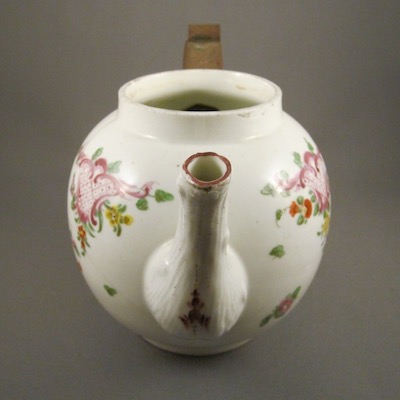
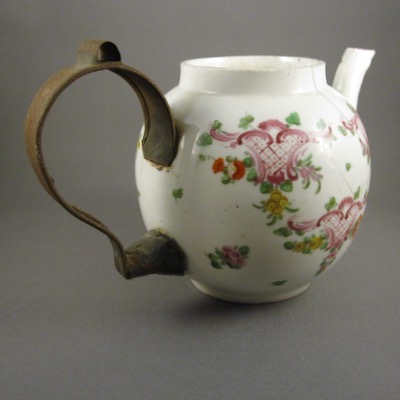
				<content:encoded><![CDATA[<p>A fine example of a globular form porcelain teapot made in England by Worcester in the 3rd quarter of the 18th century, it is hand painted with polychrome enamels in the Conjurer pattern, with unusual cobalt blue underglaze rim decoration.</p>
<p><a href="http://andrewbaseman.com/blog/wp-content/uploads/IMG_5531.jpg"><img alt="IMG_5531" src="http://andrewbaseman.com/blog/wp-content/uploads/IMG_5531.jpg" width="400" height="320" /></a></p>
<p><a href="http://andrewbaseman.com/blog/wp-content/uploads/IMG_5532.jpg"><img alt="IMG_5532" src="http://andrewbaseman.com/blog/wp-content/uploads/IMG_5532.jpg" width="400" height="394" /></a></p>
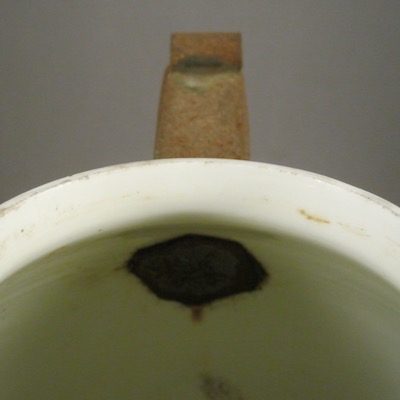
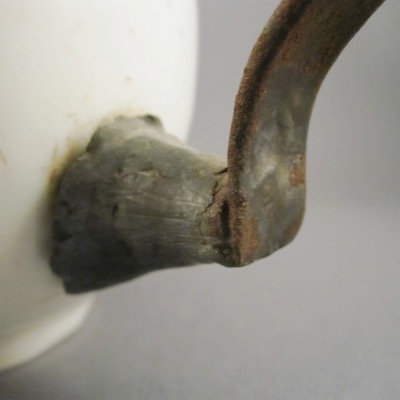
<p>Teapot measures  7-1/2&#8243; wide from handle to spout and stands 4-1/2&#8243; high minus its original flower finial lid. Metal replacement spouts on teapots are one of the most common inventive repairs I encounter and I have dozens of examples ranging from crudely cut tin, to ornately chased silver.</p>
<p><a href="http://andrewbaseman.com/blog/wp-content/uploads/IMG_5536.jpg"><img alt="IMG_5536" src="http://andrewbaseman.com/blog/wp-content/uploads/IMG_5536.jpg" width="400" height="322" /></a></p>
<p><a href="http://andrewbaseman.com/blog/wp-content/uploads/IMG_5533.jpg"><img alt="IMG_5533" src="http://andrewbaseman.com/blog/wp-content/uploads/IMG_5533.jpg" width="400" height="427" /></a></p>
<p>I purchased this one a few months ago under the guise of the spout&#8217;s having a typical metal replacement, as I was interested in owning my first Worcester teapot. But as I unpacked, upon closer inspection I discovered that the replacement spout was actually a repurposed 19th century sterling silver thimble!</p>
<p><a href="http://andrewbaseman.com/blog/wp-content/uploads/IMG_5534.jpg"><img alt="IMG_5534" src="http://andrewbaseman.com/blog/wp-content/uploads/IMG_5534.jpg" width="400" height="335" /></a></p>
<p><a href="http://andrewbaseman.com/blog/wp-content/uploads/IMG_5537.jpg"><img alt="IMG_5537" src="http://andrewbaseman.com/blog/wp-content/uploads/IMG_5537.jpg" width="400" height="360" /></a></p>
<p>What an ingenious solution to saving two precious, much used household objects. It seems that the thimble, which must have been jabbed by a needle one too many times, and finally bearing a hole in the end, was crudely cut at an angle and cemented to the damaged end of the ceramic spout. With such a simple DIY solution, I am surprised I haven&#8217;t seen more repairs done in this manner. I can only imagine that had Hints from Heloise appeared in 19th century newspapers, there would be many more examples like this in existence today.</p>
<p><a href="http://andrewbaseman.com/blog/wp-content/uploads/IMG_5538.jpg"><img class="alignnone size-full wp-image-7289" alt="IMG_5538" src="http://andrewbaseman.com/blog/wp-content/uploads/IMG_5538.jpg" width="400" height="358" /></a></p>
<p>Another Worcester example with similar form and decoration shows what the lid and end of the spout would have looked like on my teapot.</p>
<p><a href="http://andrewbaseman.com/blog/wp-content/uploads/worcester.jpg"><img class="alignnone size-full wp-image-7298" alt="worcester" src="http://andrewbaseman.com/blog/wp-content/uploads/worcester.jpg" width="400" height="322" /></a></p>
<p>Photo courtesy of <a href="http://www.trocadero.com">Trocadero</a></p>
]]></content:encoded>
			<wfw:commentRss>http://andrewbaseman.com/blog/?feed=rss2&#038;p=7288</wfw:commentRss>
		<slash:comments>4</slash:comments>
		</item>
		<item>
		<title>Pair of armorial sauce boats, c.1790</title>
		<link>http://andrewbaseman.com/blog/?p=7107</link>
		<comments>http://andrewbaseman.com/blog/?p=7107#comments</comments>
		<pubDate>Sun, 07 Apr 2013 13:54:07 +0000</pubDate>
		<dc:creator>Andrew Baseman</dc:creator>
				<category><![CDATA[sauce boat]]></category>
		<category><![CDATA[armorial]]></category>
		<category><![CDATA[blue & white]]></category>
		<category><![CDATA[brass]]></category>
		<category><![CDATA[Chinese]]></category>
		<category><![CDATA[metal handle]]></category>
		<category><![CDATA[porcelain]]></category>
		<category><![CDATA[rattan]]></category>

		<guid isPermaLink="false">http://andrewbaseman.com/blog/?p=7107</guid>
		<description><![CDATA[As collectors, we all have stories of &#8220;the one that got away&#8221; and for me it happened in June 1991, on the very first day I started collecting antiques with inventive repairs. Having landed in London the night before and still jet lagged, I stumbled down Portobello Road and wandered into a crowded stall selling porcelains. [...]]]></description>
				<content:encoded><![CDATA[<p>As collectors, we all have stories of &#8220;the one that got away&#8221; and for me it happened in June 1991, on the very first day I started collecting antiques with inventive repairs. Having landed in London the night before and still jet lagged, I stumbled down Portobello Road and wandered into a crowded stall selling porcelains. I spotted a <a href="http://andrewbaseman.com/blog/?p=1245">pair of Chinese Export sauce boats</a> each with a replaced metal loop handle. Pleading with the dealer to sell me just one, which I could barely afford, she broke up the pair and I happily walked away with what would be the start of my collection. Even then, I immediately regretted not being able to afford its mate, but I was pleased to at least own the one. To this day, I keep hoping I will come across the orphan I left behind and be able to reunite the two. So, if anyone can help me locate the long lost twin, I will be forever grateful and you will be rewarded for your excellent sleuthing!</p>
<p>The lone survivor of my maddening &#8220;Sophie&#8217;s Choice&#8221; moment</p>
<p><a href="http://andrewbaseman.com/blog/wp-content/uploads/IMG_22011.jpg"><img class="alignnone size-full wp-image-7207" alt="IMG_2201" src="http://andrewbaseman.com/blog/wp-content/uploads/IMG_22011.jpg" width="400" height="273" /></a></p>
<p>You can imagine how happy I was to have been recently contacted by dealer <a href="http://www.pollylatham.com">Polly Latham</a> of Boston, MA, offering me a pair of Chinese Export sauce boats, each with identical replacement handles and decorated with an armorial coat of arms, no less. This pair, a part of a larger dinner service, was made for export to the English market at the end of the 18th century and bear the Arms of Maitland, 8th Earl of Lauderdale (1759-1839). Maitland, a noted statesman, politician and controversial social and political critic of his time, criticized the clergy, condemned slavery and was an ardent supporter of the French Revolution. The motto under the coat-of-arms, intricately painted in polychrome enamels with gilt highlights, translates to &#8220;Wisdom and Courage&#8221;.</p>
<p>I am pleased to proclaim that as long as I am the caretaker of this fine pair, they shall remain unseparated.</p>
<p><a href="http://andrewbaseman.com/blog/wp-content/uploads/IMG_6819-Version-2.jpg"><img alt="IMG_6819 - Version 2" src="http://andrewbaseman.com/blog/wp-content/uploads/IMG_6819-Version-2.jpg" width="400" height="253" /></a></p>
<p><a href="http://andrewbaseman.com/blog/wp-content/uploads/IMG_6818.jpg"><img alt="IMG_6818" src="http://andrewbaseman.com/blog/wp-content/uploads/IMG_6818.jpg" width="400" height="340" /></a></p>
<p><a href="http://andrewbaseman.com/blog/wp-content/uploads/IMG_6841.jpg"><img alt="IMG_6841" src="http://andrewbaseman.com/blog/wp-content/uploads/IMG_6841.jpg" width="400" height="308" /></a></p>
<p><a href="http://andrewbaseman.com/blog/wp-content/uploads/IMG_6842.jpg"><img alt="IMG_6842" src="http://andrewbaseman.com/blog/wp-content/uploads/IMG_6842.jpg" width="400" height="325" /></a></p>
<p>The replaced handles are made of forged brass, covered in woven rattan, and pinned to the end of the sauce boats with two metal rivets. The rattan covering is not only decorative but also used to insulate the metal handle from the hot contents.</p>
<p><a href="http://andrewbaseman.com/blog/wp-content/uploads/IMG_6833-2.jpg"><img alt="IMG_6833-2" src="http://andrewbaseman.com/blog/wp-content/uploads/IMG_6833-2.jpg" width="400" height="263" /></a></p>
<p><a href="http://andrewbaseman.com/blog/wp-content/uploads/IMG_6835-2.jpg"><img class="alignnone size-full wp-image-7198" alt="IMG_6835-2" src="http://andrewbaseman.com/blog/wp-content/uploads/IMG_6835-2.jpg" width="400" height="300" /></a></p>
<p><a href="http://andrewbaseman.com/blog/wp-content/uploads/IMG_6840-2.jpg"><img alt="IMG_6840-2" src="http://andrewbaseman.com/blog/wp-content/uploads/IMG_6840-2.jpg" width="400" height="300" /></a></p>
<p><a href="http://andrewbaseman.com/blog/wp-content/uploads/IMG_6826-2.jpg"><img class="alignnone size-full wp-image-7200" alt="IMG_6826-2" src="http://andrewbaseman.com/blog/wp-content/uploads/IMG_6826-2.jpg" width="400" height="290" /></a></p>
<p>Take a look at the rest of the large dinner service, all bearing the arms of Maitland, including a pair of identical sauce boats with original handles intact, located in the center of the middle shelf.</p>
<p><a href="http://andrewbaseman.com/blog/wp-content/uploads/20130322_0343.jpg"><img class="alignnone size-full wp-image-7206" alt="20130322_0343" src="http://andrewbaseman.com/blog/wp-content/uploads/20130322_0343.jpg" width="400" height="587" /></a></p>
<p>Photo courtesy of <a href="http://www.pollylatham.com">P</a><a href="http://www.pollylatham.com">olly Latham Antiques</a></p>
]]></content:encoded>
			<wfw:commentRss>http://andrewbaseman.com/blog/?feed=rss2&#038;p=7107</wfw:commentRss>
		<slash:comments>3</slash:comments>
		</item>
		<item>
		<title>Small toy cannon, c.1880</title>
		<link>http://andrewbaseman.com/blog/?p=7191</link>
		<comments>http://andrewbaseman.com/blog/?p=7191#comments</comments>
		<pubDate>Sun, 31 Mar 2013 11:55:16 +0000</pubDate>
		<dc:creator>Andrew Baseman</dc:creator>
				<category><![CDATA[toy]]></category>
		<category><![CDATA[American]]></category>
		<category><![CDATA[brass]]></category>
		<category><![CDATA[miniature]]></category>
		<category><![CDATA[wood base]]></category>

		<guid isPermaLink="false">http://andrewbaseman.com/blog/?p=7191</guid>
		<description><![CDATA[I hit the jackpot this past November while visiting friends in southern Vermont for the Thanksgiving holiday. On &#8220;Black Friday&#8221;, my dear friend Hilary and I ventured out to visit a few local antiques shops when I stumbled upon a set of three toy cannons, graduating in size, and each with a unique inventive repair. [...]]]></description>
				<content:encoded><![CDATA[<p>I hit the jackpot this past November while visiting friends in southern Vermont for the Thanksgiving holiday. On &#8220;Black Friday&#8221;, my dear friend Hilary and I ventured out to visit a few local antiques shops when I stumbled upon a set of three toy cannons, graduating in size, and each with a unique inventive repair.</p>
<p>This little gem, the smallest of the three, measures 3-1/2&#8243; long and is 1-1/2&#8243; tall. The tiny cast brass barrel, with its lovely green patina, is set in to the simple, yet effective, replacement base carved from a small block of wood, and held in place by two metal loops.</p>
<p>I particularly like the the three steps in the back and how the top of the wooden base was carved out in the exact shape of the cannon&#8217;s barrel so it would fit snugly in place. The dark greenish-brown painted surface remains mostly intact but shows some wear due, no doubt, to endless hours of battles played out in the safe confines of a patriotic young boy&#8217;s back yard. These toy cannons might have been manufactured in 1876, to help commemorate America&#8217;s centennial.</p>
<p>I will be posting the other two cannons from the same lot in the coming months, so be on the lookout. And please take a look at another small <a href="http://andrewbaseman.com/blog/?p=258">toy cannon</a>, with a much cruder home-made repair, previously posted in these pages.</p>
<p><a href="http://andrewbaseman.com/blog/wp-content/uploads/IMG_5457.jpg"><img alt="IMG_5457" src="http://andrewbaseman.com/blog/wp-content/uploads/IMG_5457.jpg" width="400" height="300" /></a></p>
<p><a href="http://andrewbaseman.com/blog/wp-content/uploads/IMG_5459.jpg"><img alt="IMG_5459" src="http://andrewbaseman.com/blog/wp-content/uploads/IMG_5459.jpg" width="400" height="315" /></a></p>
<p><a href="http://andrewbaseman.com/blog/wp-content/uploads/IMG_5460.jpg"><img alt="IMG_5460" src="http://andrewbaseman.com/blog/wp-content/uploads/IMG_5460.jpg" width="400" height="374" /></a></p>
<p><a href="http://andrewbaseman.com/blog/wp-content/uploads/IMG_5458.jpg"><img alt="IMG_5458" src="http://andrewbaseman.com/blog/wp-content/uploads/IMG_5458.jpg" width="400" height="282" /></a></p>
<p>&nbsp;</p>
<p>This toy cast iron ship’s signal cannon from the early 1800s shows what the original base on my cannon might have looked like.</p>
<p><a href="http://andrewbaseman.com/blog/wp-content/uploads/IRONCANNLFTSIDVW0271.jpg"><img alt="IRONCANNLFTSIDVW027" src="http://andrewbaseman.com/blog/wp-content/uploads/IRONCANNLFTSIDVW0271.jpg" width="399" height="259" /></a></p>
<p>&nbsp;</p>
<p>Photo courtesy of <a href="http://landandseacollection.com/">Land and Sea Collection</a></p>
]]></content:encoded>
			<wfw:commentRss>http://andrewbaseman.com/blog/?feed=rss2&#038;p=7191</wfw:commentRss>
		<slash:comments>2</slash:comments>
		</item>
		<item>
		<title>Eva Zeisel majolica teapot, c.1929</title>
		<link>http://andrewbaseman.com/blog/?p=6967</link>
		<comments>http://andrewbaseman.com/blog/?p=6967#comments</comments>
		<pubDate>Sun, 24 Mar 2013 01:29:16 +0000</pubDate>
		<dc:creator>Andrew Baseman</dc:creator>
				<category><![CDATA[teapot]]></category>
		<category><![CDATA[German]]></category>
		<category><![CDATA[pottery]]></category>
		<category><![CDATA[rattan]]></category>
		<category><![CDATA[staples/rivets]]></category>

		<guid isPermaLink="false">http://andrewbaseman.com/blog/?p=6967</guid>
		<description><![CDATA[This boldly painted, hard to find teapot was designed by no other than Eva Zeisel, who worked for Majolika Fabrik in Schramberg, Germany. She arrived in the small Black Forest town in the fall of 1928 and left nearly two years later in the spring of 1930, creating nearly 200 brightly colored pottery objects of Art [...]]]></description>
				<content:encoded><![CDATA[<p>This boldly painted, hard to find teapot was designed by no other than <a href="http://en.wikipedia.org/wiki/Eva_Zeisel">Eva Zeisel</a>, who worked for Majolika Fabrik in Schramberg, Germany. She arrived in the small Black Forest town in the fall of 1928 and left nearly two years later in the spring of 1930, creating nearly 200 brightly colored pottery objects of Art Deco inspired design. This lightweight pottery teapot measures 7-1/2&#8243; tall and is 8-3/4&#8243; wide from handle to spout.</p>
<p><a href="http://andrewbaseman.com/blog/wp-content/uploads/IMG_56441.jpg"><img alt="IMG_5644" src="http://andrewbaseman.com/blog/wp-content/uploads/IMG_56441.jpg" width="400" height="363" /></a></p>
<p><a href="http://andrewbaseman.com/blog/wp-content/uploads/IMG_5652.jpg"><img alt="IMG_5652" src="http://andrewbaseman.com/blog/wp-content/uploads/IMG_5652.jpg" width="400" height="454" /></a></p>
<p><a href="http://andrewbaseman.com/blog/wp-content/uploads/IMG_5650.jpg"><img alt="IMG_5650" src="http://andrewbaseman.com/blog/wp-content/uploads/IMG_5650.jpg" width="400" height="370" /></a></p>
<p>I am not surprised that this fragile teapot did not remain unscathed over the past 84 years, as the low fired clay is susceptible to breakage. A large broken piece at the top of the pot has been reapplied, aided by three large metal staples, each measuring nearly 3/4&#8243; long. To help camouflage this none-too-subtle repair, the staples were overpainted in matching tones, with only traces of color remaining. To add insult to injury, the top  portion of the handle, once broken off, has been riveted back on to the body. Tightly woven rattan envelopes the entire handle and the lower portion of the teapot, although I am not sure if this is was a later addition. Original or not, the basket-like embellishment adds another layer of quirkiness to this most desirable vessel.</p>
<p><a href="http://andrewbaseman.com/blog/wp-content/uploads/IMG_5646-Version-2.jpg"><img class="alignnone size-full wp-image-7153" alt="IMG_5646 - Version 2" src="http://andrewbaseman.com/blog/wp-content/uploads/IMG_5646-Version-2.jpg" width="400" height="218" /></a></p>
<p><a href="http://andrewbaseman.com/blog/wp-content/uploads/IMG_5648.jpg"><img class="alignnone size-full wp-image-7044" alt="IMG_5648" src="http://andrewbaseman.com/blog/wp-content/uploads/IMG_5648.jpg" width="400" height="300" /></a></p>
<p><a href="http://andrewbaseman.com/blog/wp-content/uploads/IMG_56511.jpg"><img class="alignnone size-full wp-image-7048" alt="IMG_5651" src="http://andrewbaseman.com/blog/wp-content/uploads/IMG_56511.jpg" width="400" height="331" /></a></p>
<p>The stamped mark on the bottom reads: Majolika, SMF (contained within a shield), Schramberg Handyemalt, 64.</p>
<p><a href="http://andrewbaseman.com/blog/wp-content/uploads/IMG_5655.jpg"><img alt="IMG_5655" src="http://andrewbaseman.com/blog/wp-content/uploads/IMG_5655.jpg" width="400" height="357" /></a></p>
<p><a href="http://andrewbaseman.com/blog/wp-content/uploads/Screen-Shot-2013-03-23-at-1.31.05-PM.jpg"><img alt="Screen Shot 2013-03-23 at 1.31.05 PM" src="http://andrewbaseman.com/blog/wp-content/uploads/Screen-Shot-2013-03-23-at-1.31.05-PM.jpg" width="377" height="593" /></a></p>
<p>Photo courtesy of <a href="http://www.berlin.de">Kulturprojekte Berlin</a></p>
<p>These are more examples of majolica designed by Eva Zeisel during her years in Schramberg, Germany</p>
<p><a href="http://andrewbaseman.com/blog/wp-content/uploads/Eva-Zeisel-10_525.jpg"><img class="alignnone size-full wp-image-7154" alt="Eva-Zeisel-10_525" src="http://andrewbaseman.com/blog/wp-content/uploads/Eva-Zeisel-10_525.jpg" width="400" height="294" /></a></p>
<p>An early photograph of Eva Zeisel in her studio, c. 1930.</p>
<p><a href="http://andrewbaseman.com/blog/wp-content/uploads/Eva-Zeisel-5_525-1.jpg"><img class="alignnone size-full wp-image-7155" alt="Eva-Zeisel-5_525-1" src="http://andrewbaseman.com/blog/wp-content/uploads/Eva-Zeisel-5_525-1.jpg" width="400" height="407" /></a></p>
<p>Photos courtesy of <a href="http://observatory.designobserver.com">John Foster</a></p>
]]></content:encoded>
			<wfw:commentRss>http://andrewbaseman.com/blog/?feed=rss2&#038;p=6967</wfw:commentRss>
		<slash:comments>6</slash:comments>
		</item>
		<item>
		<title>Chinoiserie print ale mug, c.1790</title>
		<link>http://andrewbaseman.com/blog/?p=2910</link>
		<comments>http://andrewbaseman.com/blog/?p=2910#comments</comments>
		<pubDate>Sun, 17 Mar 2013 16:11:29 +0000</pubDate>
		<dc:creator>Andrew Baseman</dc:creator>
				<category><![CDATA[mug/tankard]]></category>
		<category><![CDATA[blue & white]]></category>
		<category><![CDATA[English]]></category>
		<category><![CDATA[pearlware]]></category>
		<category><![CDATA[porcelain]]></category>
		<category><![CDATA[staples/rivets]]></category>

		<guid isPermaLink="false">http://andrewbaseman.com/blog/?p=2910</guid>
		<description><![CDATA[This substantial ale mug was manufactured at the turn of the 18th century, possibly by Caughley, in Shropshire, England. It stands 5-1/2&#8243; tall and is made of soft-paste porcelain with a pearlware glaze, and decorated with a bold cobalt blue Chinoiserie fantasy transfer print. It was purchased in London by my father and given to me as my [...]]]></description>
				<content:encoded><![CDATA[<p>This substantial ale mug was manufactured at the turn of the 18th century, possibly by Caughley, in Shropshire, England. It stands 5-1/2&#8243; tall and is made of soft-paste porcelain with a pearlware glaze, and decorated with a bold cobalt blue Chinoiserie fantasy transfer print. It was purchased in London by my father and given to me as my 40th birthday present. Seeing it reminds me of how proud he was when he found pieces to add to my numerous collections. Although it has just 2 small brass staples by the handle and not an over abundance of obvious repairs, as more typically seen in these pages, I am still very happy to own it.</p>
<p><a href="http://andrewbaseman.com/blog/wp-content/uploads/IMG_3470.jpg"><img class="alignnone size-full wp-image-3011" title="IMG_3470" alt="" src="http://andrewbaseman.com/blog/wp-content/uploads/IMG_3470.jpg" width="399" height="355" /></a></p>
<p><a href="http://andrewbaseman.com/blog/wp-content/uploads/IMG_3471.jpg"><img class="alignnone size-full wp-image-3013" title="IMG_3471" alt="" src="http://andrewbaseman.com/blog/wp-content/uploads/IMG_3471.jpg" width="399" height="414" /></a></p>
<p><a href="http://andrewbaseman.com/blog/wp-content/uploads/IMG_3472.jpg"><img class="alignnone size-full wp-image-3014" title="IMG_3472" alt="" src="http://andrewbaseman.com/blog/wp-content/uploads/IMG_3472.jpg" width="399" height="345" /></a></p>
<p><a href="http://andrewbaseman.com/blog/wp-content/uploads/IMG_3473.jpg"><img class="alignnone size-full wp-image-3015" title="IMG_3473" alt="" src="http://andrewbaseman.com/blog/wp-content/uploads/IMG_3473.jpg" width="399" height="405" /></a></p>
<p><a href="http://andrewbaseman.com/blog/wp-content/uploads/IMG_3474.jpg"><img class="alignnone size-full wp-image-3016" title="IMG_3474" alt="" src="http://andrewbaseman.com/blog/wp-content/uploads/IMG_3474.jpg" width="400" height="300" /></a></p>
<p><a href="http://andrewbaseman.com/blog/wp-content/uploads/IMG_3475.jpg"><img class="alignnone size-full wp-image-3018" title="IMG_3475" alt="" src="http://andrewbaseman.com/blog/wp-content/uploads/IMG_3475.jpg" width="399" height="355" /></a></p>
]]></content:encoded>
			<wfw:commentRss>http://andrewbaseman.com/blog/?feed=rss2&#038;p=2910</wfw:commentRss>
		<slash:comments>5</slash:comments>
		</item>
	</channel>
</rss>