Making make-do’s in Eastfield Village

June 16th, 2013

Yesterday I learned how to make replacement handles for broken vessels from Don Carpentier, the visionary behind Eastfield Village and master of all trades. Last year at Dish Camp, the annual “POTpourri” ceramics conference where I presented examples from my own collection, I mentioned that I would like to learn the craft of early repair. Don assured me that making tin replacement handles was easy and that he could teach me all I needed to know in one afternoon. Flash forward one year, I find myself in Don’s workshop Period Make-Do’s and How to Reproduce Them, learning how to cut, bend and solder tin.

I urge anyone with an interest in learning traditional trades and domestic arts to visit Eastfield Village and attend a workshop this summer. Please take a look at my post from Dish Camp 2012, which shows some of the historic buildings and links to Don’s site.

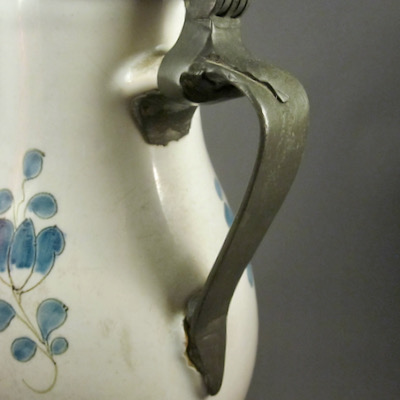
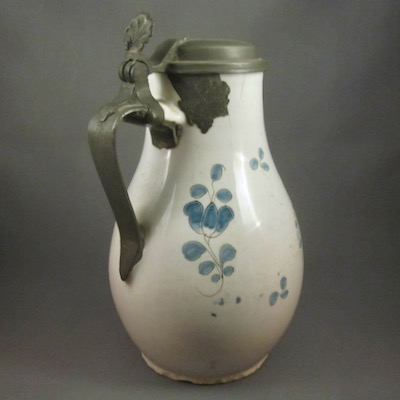
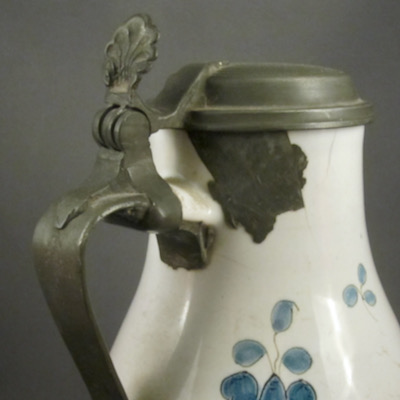
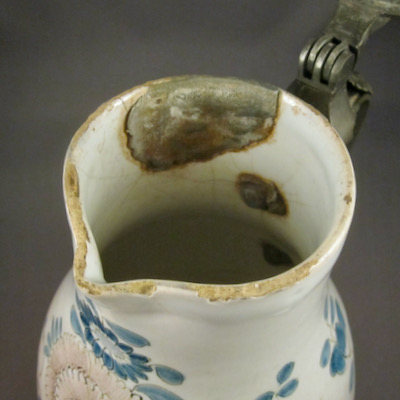
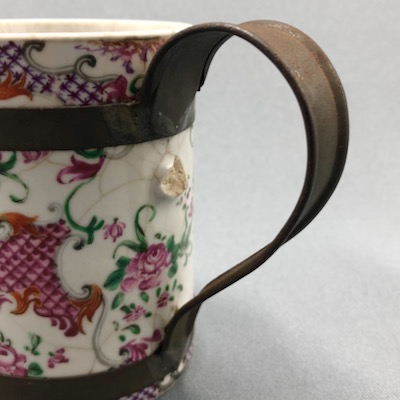
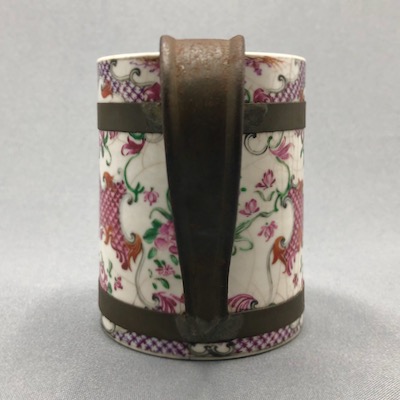
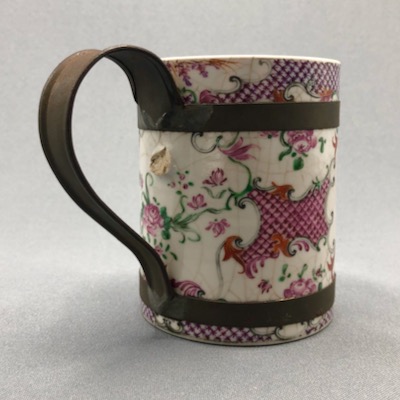
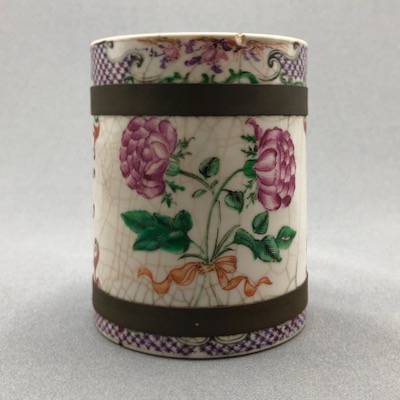
This is the finished product. I am in awe of the handle and buttress Don effortlessly created, identical to the ones made by itinerant tinkers in the 18th through 20th century in North American and Europe. The broken mocha ware jug was given to me by my mother who had kept it in her cupboard for many years, knowing that even with a missing handle and large crack, it was too good to throw out.

Image

Within seconds, Don drew a sketch of the proposed replacement handle, showing the placement of the 2 horizontal bands and the 4 vertical supports.

Image 1

After scribing a piece of tin, I carefully snip one of the 2 support bands.

Image 2

Don attaches the lower horizontal band, bending and locking the 2 ends together.

Image 3

I am placing the 4 vertical bands and marking them for Don.

Image 4

Don is soldiering the first vertical band.

Image 5

Using an original tin crimping machine from the mid 1800s, Don is embedding wire in the handle edge, which provides extra support.

Image 6

The handle is being bent and formed.

Image 7

Don has a remarkable eye and in very little time, has cut out a tiny piece at the top of the broken handle stub to allow for the new handle to fit snugly in place.

Image 8

By the 1800s, tinkers added embellishments such as thumb rests. Don thought it would be a good addition, as do I.

Image 9

Unable to drill through the body of the jug for fear of leaking contents, tinkers attached handles to whatever was left of the broken handles. Don snipped out the center part of the lower handle, leaving enough of the tin-encased wire to bend around the remains of the lower handle stub and solder to the lower support band.

Image 10

Photos courtesy of Mark Randall

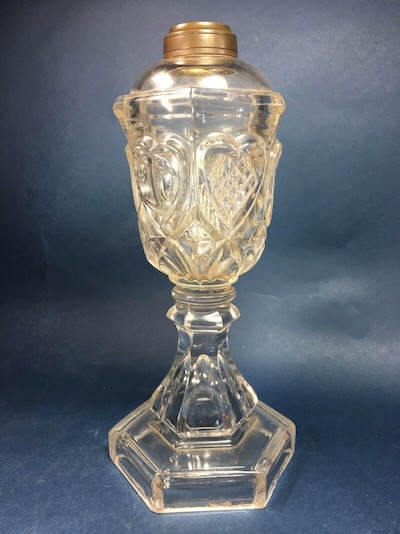
Cut crystal compote, c.1900

June 7th, 2013

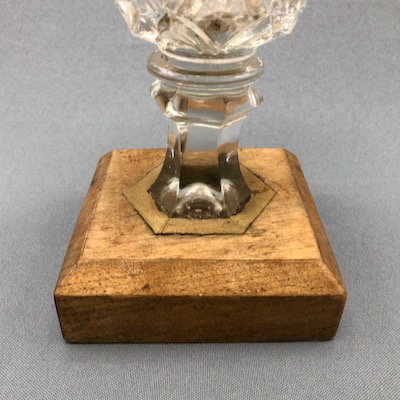
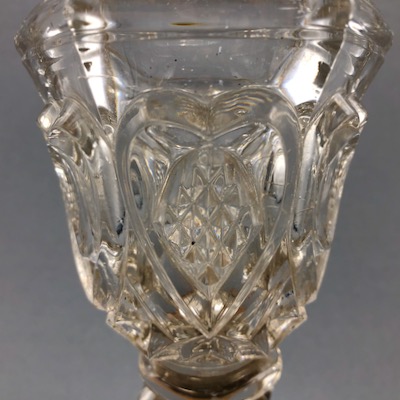
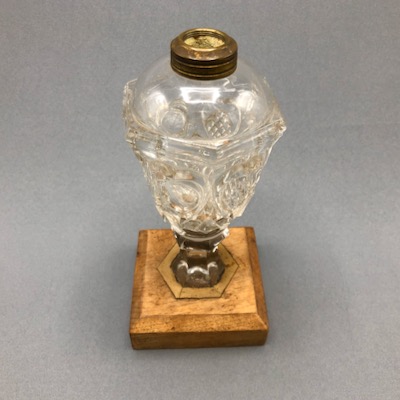
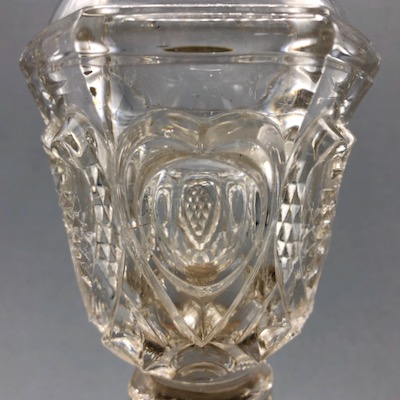
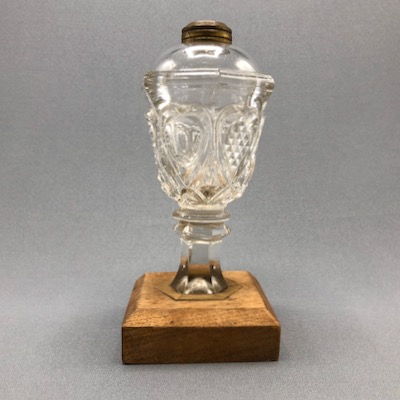
Sometime around 1920, an elegant 8″ tall crystal compote slipped out of the hands of a nervous hostess as she was serving stewed rhubarb to a dinner guest. The sudden drop to the floor not only embarrassed the hostess and stained the Persian carpet below, but also snapped the cherished heirloom in half. Luckily, her slightly annoyed but handy husband snatched up the broken diamond-cut decorated bowl and attached it to a recently discarded large wooden spool. Seeing that the marriage of crystal and wood needed further embellishment, he gilded the spool to help jazz it up. The now slightly less nervous hostess was able to enjoy the newly restored compote again, but from then on filled it only with butter mints…just to be safe.

IMG_5463

IMG_5464

IMG_5466

IMG_5465

This quartet of compotes shows a variety of original glass bases; perhaps one of which looked like mine.

lot-vintage-pressed-pattern-glass-compotes-Century-Candlewick-English-Hobnail-Laurel-Leaf-Farm-item-no-n9387-1

Photo courtesy of Laurel Leaf Farm

Magnificent Yixing teapot c.1700

May 26th, 2013

This is one of my favorite and, as it turns out, one of the rarest pieces I have in my collection. I purchased it last fall at auction where it was among a small but impressive collection of early Yixing teapots, most with silver mounts.  In total, over a dozen items were being offered; at least half were museum quality. I ended up with 2 teapots, each with multiple replacements, and I paid dearly for them. I only wish I had been able to forgo my monthly mortgage payment and purchase the entire lot so I could keep the assembled collection intact. But at least I acquired this breathtaking teapot, which in my opinion is the best of the lot, along with another rare gem, which I will post at a later date.

IMG_5503

Made in China during the Kangxi period (1662-1722), this Yixing teapot of hexagonal form is decorated with six relief molded panel designs on a diaper pattern ground and depicts spear and sword carrying warriors on horseback. The matching lid, with a beautifully carved seated lion finial, has a diaper pattern ground decorated with scrolling clouds. The intricate details make this piece special, but the exquisite silver mounts and carved wood handle make this piece magnificent.

IMG_5504

IMG_5505

When the original handle and spout broke off sometime in the first part of the 18th century, a silversmith of the highest level created these outstanding repairs and replacements. The wood handle is carved with what appears to be a scrolled leaf on top and a tiny grotesque head at the bottom, attached to the body using chased silver mounts. The spout is repaired with silver mounts at the base and at the tip, both handsomely engraved.

IMG_5507

IMG_5508

IMG_5509

IMG_6933

IMG_5512

There is a small hole at the top of the body near the spout, which I have seen on other Yixing teapots. Some of these other examples have a small silver mount covering the hole. Does anyone know if this is to allow steam to escape or why on some pieces the hole is covered?

IMG_5511

IMG_5510

IMG_5514

This teapot with similar form shows what the original loop handle would have looked like on my teapot. For more information, please take a look at other Yixing teapots I have previously posted to see a variety of forms and styles and to learn more about Yixing clay and its unique qualities.

d4880065x

Photo courtesy of Christie’s

Porcelain blue & white jug c.1785

May 18th, 2013

Chinese porcelain baluster-form hot milk jug with sparrow beak spout, made in the mid to late 18th century during the Qianlong Period (1736-1795). Delicately decorated in underglaze cobalt blue, it shows a large vase sitting on a carved wood table and filled with precious objects surrounded by flowers and a pair of bees. The scale of these objects is a bit off-kilter, which adds a whimsical quality. Jug measures 5-3/4″ high and 4″ wide to the end of handle.

The original porcelain handle was replaced over one hundred years ago with a woven wicker-covered bronze replacement. I have dozens of examples of wicker-covered metal replacement handles in my collection, as this was a standard form of inventive repair; and at first glance, the handles all look pretty much the same, but upon closer inspection, you will see a variation in the pattern of the weaving. This handle has a straightforward checkerboard weave, while some of my pieces have the rattan in more than one color and woven in a more intricate pattern. I think a post dedicated to showing the many variations of woven-handle styles would be interesting, don’t you?

This blue & white decorated jug with similar form still has its porcelain handle and lid intact. Before my jug became an example of “inventive repair” it would have looked much like this one.

b:w.jug

Photo courtesy of eBay

Basket case Victorian dish, c.1850

May 11th, 2013

In honor of Mother’s Day, I am featuring a dish that only a mother could love. I believe it to be English from the mid 1800s and made of porcelain with hand painted decoration in cobalt, drab and gold. It is marked on the bottom with the numbers 4 over 554 and measures 9″ x 10″. This is truly one of the saddest antiques with inventive repairs I have ever seen, and believe me, it took much inner soul searching just to purchase it. I am breaking with tradition and showing the underside of the plate first. Take a deep breath…this is not going to be pretty.

IMG_7067

IMG_7073

IMG_7074 - Version 3

IMG_7070

This dish must have held great sentimental value for its original owner. In order to make it “whole” again after being shattered over 100 years ago, it was professionally repaired using 10 large metal staples, overpainted to mask the unsightly raw material. Sadly, the dish was dropped AGAIN, resulting in the loss of 3 staples and a sloppy glue job, now yellow with age. To add insult to injury, later in life it was bound with a cat’s cradle worth of string and cord, so it could proudly hang on a wall for all the world to see the tenacity of this unlikely survivor.

IMG_7063 - Version 2

IMG_7079

Pierrette clothespin doll, c.1920

May 4th, 2013

This unmarked porcelain novelty was most likely produced in Germany around 1920 and measures 5-3/4″ long. Also known as half dolls, they were typically attached to tops of pincushions, boxes and small clothes brushes and displayed on vanity and dresser tops. This one graduated from half doll to full doll, with the aid of a wooden clothespin attached at the waist. I imagine that after the piece broke, a handy dad whittled the lower extremities to form makeshift prosthetic legs. In an attempt to create a respectable outfit for this coquettish lass, the clothespin legs were covered in now faded pink cloth tape, the duct tape of its day. Wouldn’t it be great if this immobile doll ended up in a doll house, filled with inventively repaired miniature furnishings and inhabitants, including a make-do Pierrot?

IMG_7051

IMG_7056

IMG_7052

IMG_7059

IMG_7055

This lovely lady sits atop a powder box and still has her original porcelain legs.

OLYMPUS DIGITAL CAMERA

Photo courtesy of LiveJournal

Redware vixen stirrup cup, c.1775

April 28th, 2013

This redware pottery figural stirrup cup was made in England in the third quarter of the 18th century and is in the form of a cunning little vixen’s head. L-shaped, it measures 4″ tall by 6-1/4″ wide and is freestanding, which is unusual, as most stirrup cups are base-less and unable to stand on their own. Stirrup cups, traditionally filled with port or sherry, were given to guests as a parting drink at the conclusion of a fox hunt, while their feet were still in their stirrups. This tradition began in the United Kingdom in the 18th century and continued for hundreds of years. As this sport never ended well for the fox, it was finally banned in Scotland in 2002 and in England and Wales just three years later.

IMG_6935

IMG_6937

IMG_6938

The original handle must have broken off after an inebriated hunter grabbed the cup at the conclusion of the hunt, downed his sherry, then promptly fell off his horse, dropping and breaking the prized vessel. I imagine the host was not pleased by the guest’s unruly behavior and surely did not invite him back anytime soon. Luckily, a metalsmith, most likely in the 19th century, came to the rescue and fashioned a new handle with support bands, thus enabling another, more sober guest to stay in the saddle and toast his gracious host.

IMG_6941

IMG_6943

An original paper label on the bottom links this cup to esteemed collector and author Frank Falkner of Cheshire, England. The June 1905 issue of Glass and Pottery World contains an article that includes this amusing excerpt: “Mr. Falkner and Mr. Lidelstham had a hobby for old pottery, but they did not follow the usual practice of collectors by acquiring rare specimens of old Sevres, Worcester, Crown Derby, Wedgwood or others of the same high class. They directed their attention to the homely figures and ornaments with which ‘the rural population of a century ago used to deck their dresser or mantel shelf. These common rustic figures, made by men who were little more than peasants themselves, had been passed over in silence for the most part even in ceramic histories.’”
IMG_6949

The Stirrup Cup by Heywood Hardy (1842-1933) shows hunters being offered drinks in figural stirrup cups by their host.

heywood-hardy-the-stirrup-cup-fox-hunting-fox-hunt

Another fine example of a rare L-shaped stirrup cup, this one is in the form of a hare, and still with its original handle.

OLYMPUS DIGITAL CAMERA

Photo courtesy of Earle D. Vandekar

Medium-sized toy cannon, c.1880

April 20th, 2013

There seems to be a multitude of original toy cannon barrels married to wood replacement bases, as I have encountered numerous examples since I started collecting antiques with inventive repairs. This fine toy was most likely made in America in the last quarter of the 19th century and is made of brass with a replaced wood base, freely carved from a block of what appears to be pine. It measures 7-1/2″ long, stands 2-3/4″ tall and the barrel alone is 3-1/2″ long. The remains of the original barrel are firmly nailed to the replacement base using a leather strap. The original green painted surface reveals much wear from years of imaginative playing. Two sets of nail holes on one side suggest perhaps a length of chain was once attached. I purchased this in the same lot as two other toy cannons, all with the same green painted surface and graduating in size. Please take a look at the smallest one, previously posted, and stay tuned for the largest example, which I will post sometime in the near future.
IMG_5452

IMG_5450

IMG_5451

IMG_5454

IMG_5455

This toy cannon, also made of brass, is in its original form and shows what mine may have looked like before the barrel was strapped on to its wood replacement base. Though not up to military code, I still prefer mine!

il_fullxfull.223920768

Photo courtesy of Esty

**UPDATE 4/23**

An astute  subscriber and former gun collector has informed me that this cute li’l toy cannon is actually made from the barrel of a REAL GUN! Please read his amusing and telling comments below, which shed some light on this toys former life on the streets, defending helpless women. And this is what the European ladies percussion muff pistol looked like when it was still intact and used as a deadly weapon, c.1840:
Screen Shot 2013-04-23 at 9.41.57 PM

Photo courtesy of Sailor in Saddle


Worcester teapot with thimble spout, c.1770

April 14th, 2013

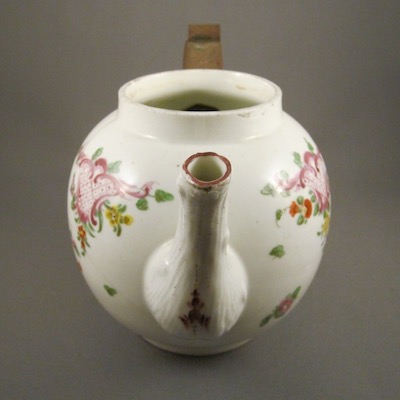
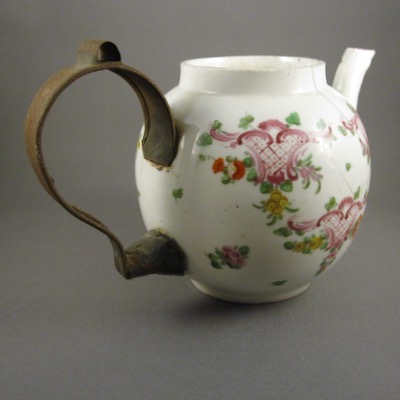
A fine example of a globular form porcelain teapot made in England by Worcester in the 3rd quarter of the 18th century, it is hand painted with polychrome enamels in the Conjurer pattern, with unusual cobalt blue underglaze rim decoration.

IMG_5531

IMG_5532

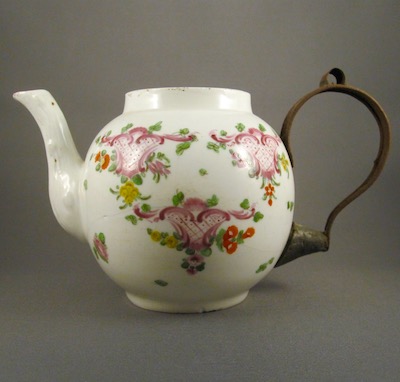
Teapot measures  7-1/2″ wide from handle to spout and stands 4-1/2″ high minus its original flower finial lid. Metal replacement spouts on teapots are one of the most common inventive repairs I encounter and I have dozens of examples ranging from crudely cut tin, to ornately chased silver.

IMG_5536

IMG_5533

I purchased this one a few months ago under the guise of the spout’s having a typical metal replacement, as I was interested in owning my first Worcester teapot. But as I unpacked, upon closer inspection I discovered that the replacement spout was actually a repurposed 19th century sterling silver thimble!

IMG_5534

IMG_5537

What an ingenious solution to saving two precious, much used household objects. It seems that the thimble, which must have been jabbed by a needle one too many times, and finally bearing a hole in the end, was crudely cut at an angle and cemented to the damaged end of the ceramic spout. With such a simple DIY solution, I am surprised I haven’t seen more repairs done in this manner. I can only imagine that had Hints from Heloise appeared in 19th century newspapers, there would be many more examples like this in existence today.

IMG_5538

Another Worcester example with similar form and decoration shows what the lid and end of the spout would have looked like on my teapot.

worcester

Photo courtesy of Trocadero

Pair of armorial sauce boats, c.1790

April 7th, 2013

As collectors, we all have stories of “the one that got away” and for me it happened in June 1991, on the very first day I started collecting antiques with inventive repairs. Having landed in London the night before and still jet lagged, I stumbled down Portobello Road and wandered into a crowded stall selling porcelains. I spotted a pair of Chinese Export sauce boats each with a replaced metal loop handle. Pleading with the dealer to sell me just one, which I could barely afford, she broke up the pair and I happily walked away with what would be the start of my collection. Even then, I immediately regretted not being able to afford its mate, but I was pleased to at least own the one. To this day, I keep hoping I will come across the orphan I left behind and be able to reunite the two. So, if anyone can help me locate the long lost twin, I will be forever grateful and you will be rewarded for your excellent sleuthing!

The lone survivor of my maddening “Sophie’s Choice” moment

IMG_2201

You can imagine how happy I was to have been recently contacted by dealer Polly Latham of Boston, MA, offering me a pair of Chinese Export sauce boats, each with identical replacement handles and decorated with an armorial coat of arms, no less. This pair, a part of a larger dinner service, was made for export to the English market at the end of the 18th century and bear the Arms of Maitland, 8th Earl of Lauderdale (1759-1839). Maitland, a noted statesman, politician and controversial social and political critic of his time, criticized the clergy, condemned slavery and was an ardent supporter of the French Revolution. The motto under the coat-of-arms, intricately painted in polychrome enamels with gilt highlights, translates to “Wisdom and Courage”.

I am pleased to proclaim that as long as I am the caretaker of this fine pair, they shall remain unseparated.

IMG_6819 - Version 2

IMG_6818

IMG_6841

IMG_6842

The replaced handles are made of forged brass, covered in woven rattan, and pinned to the end of the sauce boats with two metal rivets. The rattan covering is not only decorative but also used to insulate the metal handle from the hot contents.

IMG_6833-2

IMG_6835-2

IMG_6840-2

IMG_6826-2

Take a look at the rest of the large dinner service, all bearing the arms of Maitland, including a pair of identical sauce boats with original handles intact, located in the center of the middle shelf.

20130322_0343

Photo courtesy of Polly Latham Antiques